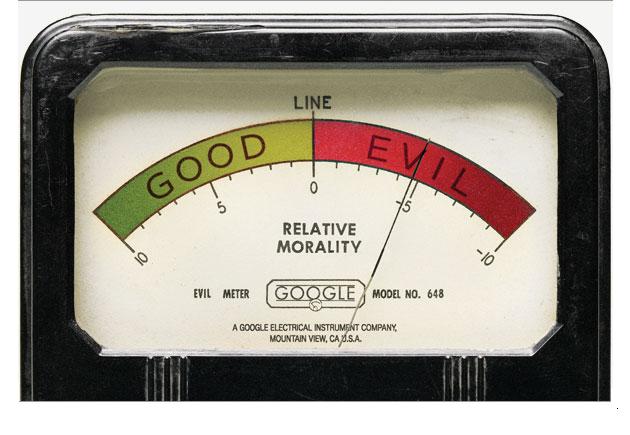


I can’t believe it. We spent a whole month talking about Mass Effect, and didn’t talk about morality or choices once. For shame. Let’s fix that.
A long, long time ago, in a post far, far away, I wrote about Spec Ops: The Line, and talked about my disappointment in how the game handled the “lack of choice” the player had. The game expected players to feel guilt over things they didn’t have a hand in choosing, and was too “meta” for it’s own good: trying to make players feel guilty about wanting to play a game. While you don’t need to have read that article to be able to follow along today, I’d highly recommend checking it out before proceeding.
Being a Hero
We’ve talked before about different kinds of heroes in video games, but we never talked about playing as a villain. Because we don’t play as villains, obviously. We are the heroes of our own stories, and video games reflect this time and time again.
But there is one game that takes you by the hand, forces you to do despicable acts in-game, punishes you for it, and leaves you questioning whether you were tactually he hero you thought you were. And, unlike Spec Ops: The Line, it is generally well received by critics and audiences alike.
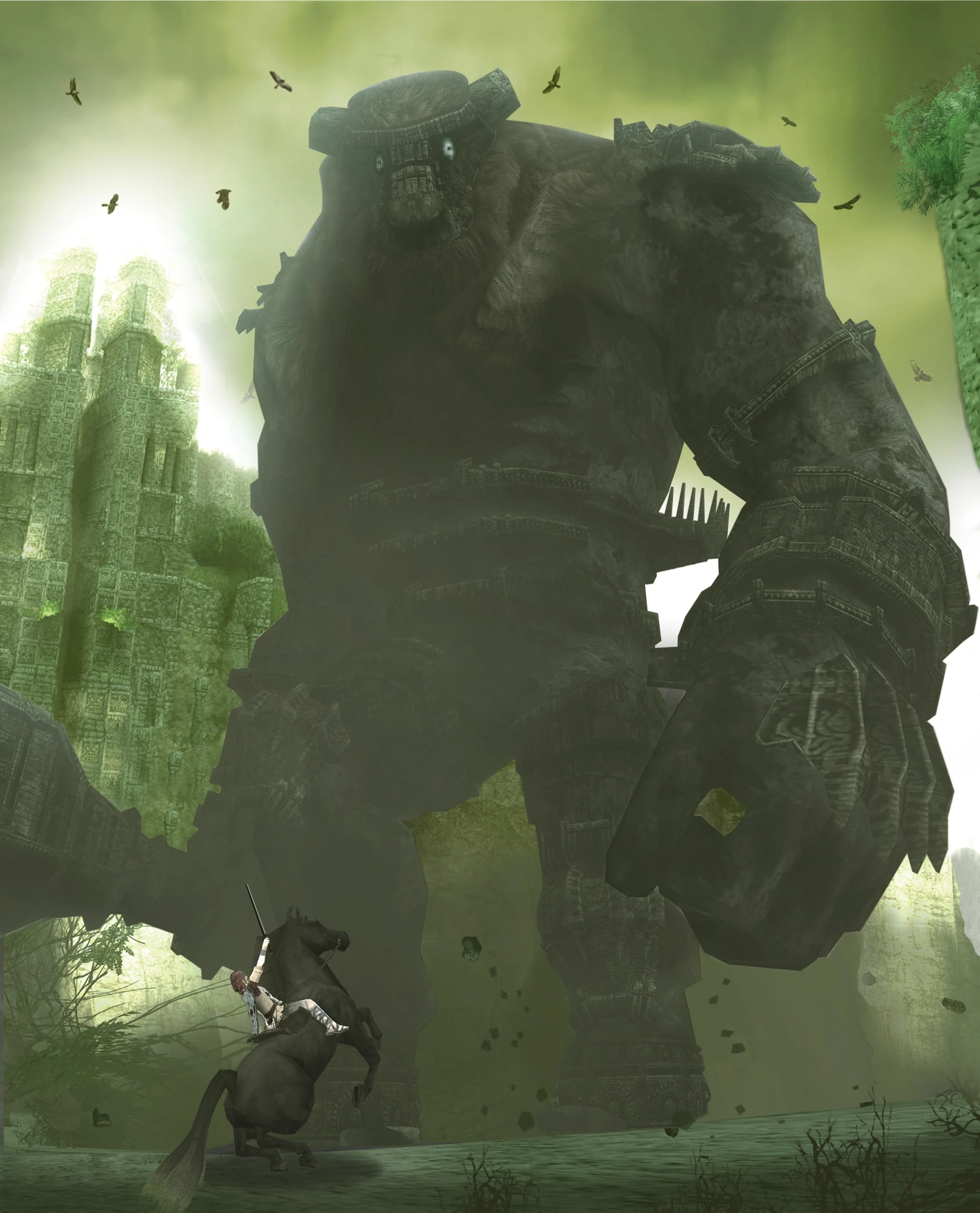
If you haven’t played Shadow of the Colossus, I highly recommend bookmarking this page, playing (or watch someone play) it, and coming back, because we’ll be talking about the plot and characters here, and while you can absolutely skip over the story by scrolling down to “The Sticking Point,” plot points are going to be discussed there, as well. If you’re still here with me (or if you just came back!), let’s dive in!
The Story
Shadow of the Colossus is so much fantasy. You control Wander, a man who has trekked to the Forbidden Lands with his love interest, Mono, who has been sacrificed because of an undisclosed “cursed destiny.” Distraught due to the loss of his true love, Wander beseeches the god Dormin – a god with the power to revive the dead – to resurrect the woman he loves.

Dormin is all to happy to help Wander, under one condition: he must travel the Forbidden Lands and kill sixteen Colossi – huge animal-like creatures that have been asleep in the Forbidden Lands for ages.
Seems reasonable, so off Wander goes to slay the beasts and reunite with his beloved Mono.
The Sticking Point
I can’t completely blame the player for willingly following along and not questioning their actions. After all, we as game enthusiasts have been conditioned to think of ourselves as the protagonist in the story we’re playing, or – perhaps worse – we’ve been conditioned to not think so hard about the games we’re playing.
I also can’t fault the player for not looking at the name Dormin, spelling it backwards, and then connecting that name (Nimrod) to an ancient kind who, according to the Book of Jasher (a book of Hebrew stories and songs not included in the Bible), was cut up into 16 pieces.*
Now, let’s run with that for a moment. Nimrod wasn’t a great guy, according to the texts he shows up in. He is a man – often portrayed as a king – who defies the Judeo-Christian god time and time again. He is, by the lens he is portrayed through, a “bad guy.” He also comments (to Abraham) that “I give life and cause death.” (The Qur’an, Surat al-Baqarah, 2:258). Interesting, considering Dormin, the shadowy god in Shadow of the Colossus, is a god that can resurrect the deceased.
All Who Wander…
It is against this backdrop that the player takes control of Wander, tasked with killing sixteen giant creatures by a disembodied voice. Because we, as players, have opted to play the game, we obediently begin traversing the Forbidden Lands on our quest. After all, a man vanquishing a monster in a video game to save a woman is as old as 1981’s Donkey Kong, and that theme dates farther back than even that when taking movies and books into account. That man is always the hero, and we’ve been conditioned, as mentioned above, to see ourselves as the protagonist in a game’s story by default.
But there is a razor-thin edge between being a hero, and being a villain. First, let’s break down Wander’s character a little bit. Most forums I’ve come across discuss Wander’s movements as evidence of his youth or inexperience. He is so small compared to the landscape, and the game take every opportunity to showcase this. He has trouble steering Agro at the beginning of the game (which is supported by the game’s mechanics, as you don’t control Agro, but rather you control Wander, who in turns controls Agro – a much different experience than most games that require you to “drive” something!). When he draws his sword, it flops around at his side haphazardly, instead of being held firmly like an experienced warrior would hold it.
So he is young and/or inexperienced. But there is no crime in that. He is rash, as he defied Emon – a high-priest character – by stealing a sacred sword and venturing to the Forbidden Lands in the first place. And the big one: he’s selfish. His love of Mono has blinded him to the consequences of his actions, driving him to accept the help of a god sealed away. A god who even tells Wander that what he’s asking is against mortal law, and that his actions might have unintended consequences.

But no, Wander doesn’t hesitate. Any consequence is worth it to bring back Mono and mend his grieving heart.
In the Shadow
Then you have the Colossi themselves. The Colossi are huge creatures that lumber around their respective areas slowly, and it’s easy to picture them being used to having nothing to do and endless hours in which to do it. However, while Wander’s quest to save his beloved is an old and familiar theme, the Colossi do not act like the old, familiar monsters. They slowly amble around their areas, not taking notice of Wander until he interacts with them in some way. If he tries to climb them, they try to shake him off (because who wants to be climbed on, really?), and if he shoots arrows at them, they enter an “alert” state and then move to defend themselves.
Defend themselves. That’s a strange way to look at it, isn’t it? But let’s take a few examples. The first Colossus you fight, Valus, meanders around with his clumb, oblivious to Wander. He’s in a relaxed state, as indicated by his blue eyes, and even as Wander climbs him, his eyes stay blue as he tries to shake Wander off.
 It’s like he thinks an animal is crawling up his back and he just wants it off. But when Wander reaches his head, the camera shifts and we can clearly see Valus’s face. His eyes light up orange (alert) when Wander stabs him (understandably so), but if Wander leaves him alone long enough, he will eventually go back to plodding around his little area.
Most of the Colossi are like this: they don’t actively hunt Wander unless he initiates a fight. They’ll try to seek him for a short time, but if Wander leaves them alone, they go back to their lives. They’re not aggressive. They don’t attack unprovoked (for the most part).

Or, during the fight against Celosia (pictured above), a relatively small Colossus tasked with guarding a sacred fire, Wander must brandish said fire at the Colossus. Why? Because Celosia is terrified of fire. He paws nervously at Wander as the man brandishes a torch, and cowers while slowly backing away until he falls off a small cliff, destroying his armor, and Wander jumps on him and stabs him in the back.
Even during the final battle with Malus, an objectively more violent Colossus than any other one we’ve come across so far, the flow of the battle is… unnerving. After scrambling across a field getting bombarded by Malus’s fiery projectiles, and after climbing up the huge creature that is literally attached to the ground, Wander eventually finds himself on the back of Malus’s huge hand. The Colossus stops being in the alert stage, his eyes turn blue once again, and… he holds his hand steady and studies Wander. That’s all. He watches the little human watch him, without throwing him to his death, without harming him. He is curious about the creature, and waits to see what Wander will do next before responding. Of course, Wander – and therefore we – have our mission to destroy the Colossus, so the battle continues.
But to have had a chance to throw Wander to the ground, only to use the opportunity to peer more closely at the creature, says volumes about the Colossus. It also says volumes about Wander, that he would attack a being that does not seem interested in harming him.
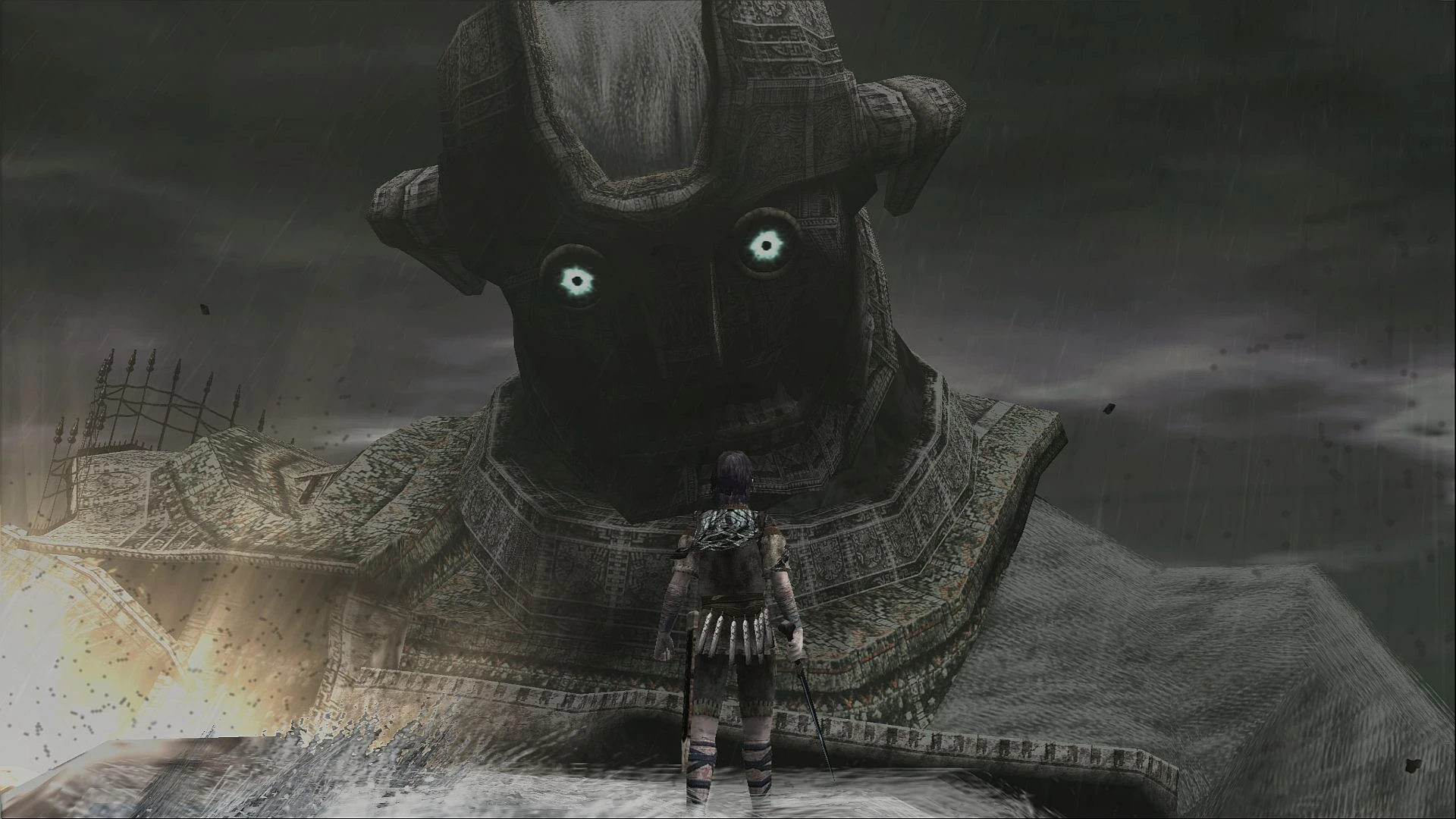
Shadow of Discomfort
Long before the end, though, many players begin to think that maybe Wander isn’t as heroic as originally thought. The music that plays at the end of each Colossus battle is not the triumphant sounds of a job well done (think Final Fantasy, Legend of Zelda, or, well, any game that has a sound after a big boss battle). Instead, the music gets softer, more contemplative, and is actually quite sad.
But players continue, watching how the effects of Wander’s actions affect him, making his skill grey while simultaneously granting him more power. Many players report having emotional reactions to losing Agro, a companion who has only ever helped you/Wander, and who you/Wander may have caused to die through your inability to see any other path than the one you were on. That real guilt is powerful, and it continues to force you to question, “Is this worth what I’m doing?”
Indeed, is it worth losing who we are in the name of blindly following a cause?
To Wander, the answer is always yes. And so the player is dragged along for the ride, watching his goal drive him ever-onward. As each Colossus statue crumbles in the temple, we the players, for most of the game, are treated to seeing the statues be destroyed, but as the game goes on, we see Wander’s focus (and therefore ours) shift onto Mono as he ignores the destruction of another creature because he only has one thought in his mind: bring Mono back, whatever the cost, whatever the consequences. It costs him his health. It costs him his horse. And it costs him the happily ever after he so desperately wanted.
Punch to the Gut
In the end, Wander’s single-mindedness destroys him, making him into a version of the creatures standing between him and his goal. But now he stands between himself and his goal. He has become his own colossus.
The Moral of the Story
In a world ruled by soundbites spread across social media, and in a time when it is so easy to find and surround ourselves with people who look, think, and act like us, it can be easy to forget that our views aren’t the only ones out there if we don’t actively seek them. But what does that have to do with Shadow of Colossus?
Remember I brought up Spec Ops: The Line before? One of my biggest complaints was the missed opportunity, and how I felt like the devs were trying to shoehorn in morals that the game didn’t really portray. The game wanted me to question why I was just blindly following what the game told me to do, but sort of missed the mark. But Shadow of the Colossus succeeds. Players weren’t tricked or deceived; rather, they experienced that single-mindedness and saw how it was affecting their character. They felt a change come over them as they played (or might have) as they realized they weren’t actually acting like a hero.
The profundity that was lost in Spec Ops was captured beautifully in a game that simply lets you experience someone else’s story.
This sort of kick in the pants is good for all of us. To realize that we might not always be acting like the hero we want to be gives us a greater self-awareness, which results in us being open to new experiences, which results in new solutions to old problems (e.g., a different way of dealing with Mono’s death if Wander realized he was releasing a terrible god). In this way, we can keep ourselves from becoming our own colossus as we live our lives.
What do you think? Is Shadow of the Colossus simply a tragic story, or is there more beneath the surface? Does experiencing someone else’s story really throw our own lives into sharp relief? Let me know in the comments!
Until next time, thanks for stopping by, and I’ll see you soon!
~ Athena
**This article has some extra content available over at Patreon, if you are so inclined!**
What’s next? You can like and subscribe if you like what you’ve seen!
You can also:
– Support us on Patreon, become a revered Aegis of AmbiGaming, and access extra content!
– Say hello on Facebook, Twitter, and even Google+!
– Check out our Let’s Plays if you’re really adventurous!
*Do you know the story of how Esau – firstborn of Isaac – sold his birthright to Jacob, youngest son of Isaac? Well, long story short and according to the books in the Bible, Esau was out hunting and returned to his father’s camp famished and near death. Jacob (being a stand-up guy) withholds food until Esau “sells” him his birthright as first-born. What the Bible doesn’t say, which the Book of Jasher does, is that Esau’s fight was with the powerful Nimrod. Long story short again, eventually Esau kills Nimrod and cuts him into pieces.



 Ambigamingcorner
Leave a comment