


Oh boy! I’m going to talk about music in video games (again)!!
If you haven’t done so already, definitely check out these six times when music secretly manipulated your feelings, and these fantastic soundtracks to get lost in from our Video Game Challenge because today we’re talking about how music can manipulate your feelings and immerse you in video game worlds with less conscious effort than any amount of dialogue ever could.
Music and Structure
Roy Prendergast, a composer and music editor who has three Emmy Awards and over 75 music credits to his name, wrote a book about music in film (conveniently called Film Music). Anyway, he talked about five main ways that music can manipulate a viewer’s (or in this case, a player’s) emotions.
- Music creates a more convincing atmosphere of time and place. We make associations for different sounds, which can be used as an emotional or symbolic short-hand when used appropriately. For instance, hearing a bagpipe will instantly call up images of Scotland, muted brass is usually indicative of something sinister, and accordions can either bring up images of lederhosen or of an old Italian cafe.
- It can underline psychological information can be made obvious to the viewer/player, through the careful manipulation of the notes, instruments, tempo, and other musical elements present. That is, a character’s inner thoughts about a situation can be illustrated without uttering a word.
- Music can also serve as a kind of neutral background filler, which can also be manipulated, as I mentioned in my Metal Gear example in the first article linked above
- It builds a sense of continuity through themes, and through the reprise of those themes at key times during an experience, which we’ll talk about a bit below
- And, perhaps most familiar to all of us, music outlines the emotional structure of a scene (as composer Aaron Copland says, it underpins the “theatrical build-up of a scene, and round[s] it off with a sense of finality”)
Music and Immersion
Wow, Athena. So what does that mean for games?
As we all know, music can evoke powerful emotions in us. Without getting incredibly technical, music can active the limbic system in the brain, which is involved in our experience of emotions and our memory (among other functions). This is the reason we may experience “chills” when listening to a piece of music – the music activates the limbic system just right and we experience that wonderfully pleasurable full-body sensation that only the strongest of positive feelings can evoke.
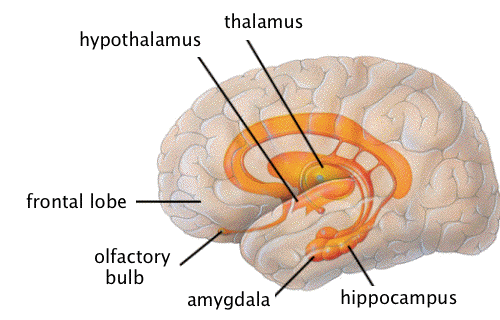
The limbic system is also involved in the creation and recollection of memories. Since music also activates the “emotion” part of the brain, though, the memories made by music tend to have an emotional component to them (although not all the time, if the piece of music doesn’t make you “feel” anything).
Music can also bring up memories of events, which can either trigger an emotional response or trigger another memory (this is something called associative memory). When taken together, these memories and emotions can work together to create a coherent, cohesive, and powerful whole.
Please note that this is a simplified explanation of what goes on in your brain… My personal enthusiasm aside, I know you all came here to read about video games!

Additionally, music can be used as a sort of “shorthand” by which audiences draw conclusions about their experience (or, in a video game, the environment, time period, and other thematic details). As I mentioned in my article on how music manipulates (linked again here), Mass Effect 2 and Mass Effect 3 do this very effectively. When Shepard meets his/her original squad mates, the theme from Mass Effect begins playing. Not only is this a way of clearly reminding us this person is a comrade from the original game – tapping into our memories – but it also taps into our feelings, giving us pleasant nostalgic feelings of the first game.
Courtesy of FluffyNinjaLlama
For another example of a “small” moment (spoilers for Dragon Age: Inquisition), if Hawke dies, the Dragon Age II theme plays when you talk to Varric and he reminisces about his friend.
Of course, games within the Zelda series also use music as a way to connect games, too, with themes recurring from game to game as each subsequent game borrows and builds on the themes that have come before, either using melodies that are reminiscent of earlier ones or employing instrumentation that holds a certain “Zelda” feeling. These elements help convey a connection between the games, but also emphasize the unique flavors that each title brings to the series. Check out the overworld themes across the ages:
Courtesy of IronicPhantom
Do you hear the thematic and/or instrumental similarities between them, even as they each offer their own variations of the “Zelda” feel?
Bait and Switch: A Music Analysis
These are all techniques that are employed frequently in movies and in video games. When done correctly, you don’t consciously notice it. In fact, it’s better if you don’t consciously notice it, because then your emotional experience is free of the constraints of conscious critique or suppression, resulting in a more profound emotional experience.
As we’ve seen in the Zelda themes and the unexpected recurrence of a theme from a previous game, it’s the little details that can highlight the thematic qualities of the game and add a little extra emotional punch.
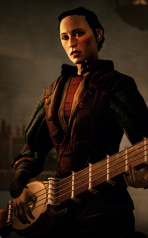
Oh, no… She looks like a character from…
All joking aside, Dragon Age: Inquisition does something very unique with its unexpectedly delightful bard songs. Not only is the inclusion of a bard and minstrel music thematically appropriate and reminiscent of the pseudo-Middle Ages in which the Dragon Ages universe exists, the game also uses the bard’s music to underline important aspects of in-game events, reinforcing that your decisions matter in the game world. People are literally singing about what you do, like minstrels did in “actual” history!
As I mentioned in my other article, if you listen to the bard songs in order, you are able to get a sense of the storyline of the game, even if you haven’t played it, because the bard is “keeping up” with the events of the game in the same way real-life minstrels might sing about the great goings-on in the world.
But let’s take a brief step back.
Specialization Unlocked: Bardic Arts
Even though most will tell you that the Dragon Age series is based off of the Middle Ages, it actually takes more of its culture and customs (and music) from the Renaissance, although it does hold onto some of the characteristics of music from the Middle Ages. For instance, in Orlais, the palace music bears a strong auditory resemblance to music from the Renaissance and early Baroque periods, from its instrument choice (bowed strings with clear and distinct harmonies) to the types of harmonies present.
The use of the lute-type instrument in the tavern at Haven and Skyhold hearkens to the Renaissance period, as well. The simple harmonies and tonalities (how the notes are used) is very reminiscent of court music during the Middle Ages.
Consider these Middle Ages songs (start around 1:20 for music with words, which our bardic songs would fall under):
Courtesy of DeutscheKinecht
And then compare to our Inquisition’s bard:
Courtesy of Hikaru Kuma
Enter Thedas (and Kindly Ignore the Fangirl in the Doorway)
There are three songs that I offer for your consideration, two of which directly tie to previous games and one that alludes to another game in a poignant way.
I talked about “The Dawn Will Come” in the linked post above, particularly how the song not only sounds like a religious hymn, but also poignantly mentions a shepherd that is lost, far from his home, and that the faithful should look to the stars, for the dawn will come.
Courtesy of DragonFire Studios
A nod to Mass Effect, anyone?
…And perhaps a little hint that another adventure in the stars is coming?
Interestingly, the bard from Inquisition also sings a song about the imposing Inquisitorial spymaster, Leliana.
Courtesy of Hikaru Kuma
The beginning of this song is a match for the introduction to the Leliana’s Song DLC from Dragon Age: Origins. Additionally, the vocal melody is the same, although the words from the DLC and Inquisition are vastly different.
Courtesy of Mouzekiller83
However, both songs are about Leliana, the DLC song being one of endurance for a woman broken, and the bard song being to a plea for help from the now-imposing woman.
And of course, an English version of “I Am the One” is also included in Inquisition. “I Am the One” is the song that plays during the credits of Dragon Age: Origins, and pops up in Inquisition after the Inquisitor – hm – fights a dragon.
Courtesy of Hikaru Kuma
There are many theories as to who this song “refers” to, but the fact that it is translated from Elvish to English and otherwise kept the same from the first game to this one is notable.
Courtesy of allaboutVGmusic
Conclusion
At the risk of saying something cliche about the power of music, the above examples illustrate that the purposeful use of music can be used to elicit emotions to heighten the power of a scene, or can create cohesive wholes across separate games by tapping into our associative memories. Through the careful manipulation of music elements, a composer can convey themes, emotions, and psychological states to a viewer/player without the use of words or additional scenery, appealing directly (and subconsciously) to the memory and emotion centers in our brains. And that’s a good thing, because these experiences not only enhance our gaming experiences, but can enrich our lives in potent and meaningful ways.
So tell me, did you learn something today, or did I just bore you to tears? Have you ever experienced chills when listening to a piece of music? What soundtracks or in-game songs do you think really capture the “feeling” or the “message” of the video game? There are a ton that I didn’t list here, so let me know in the comments!
Thanks for stopping by, and I’ll see you soon!
~ Athena
What’s next? You can like and subscribe if you like what you’ve seen!
You can also:
– Support us on Patreon, become a revered Aegis of AmbiGaming, and access extra content!
– Say hello on Facebook, Twitter, and even Google+!
– Check out our Let’s Plays if you’re really adventurous!


 Ambigamingcorner
Leave a reply to Catching Up – AmbiGaming Cancel reply