


When I first started playing Mass Effect, I was very careful to not spoil the plot for myself, other than finding out that seemingly everyone hated the endings. So there I was, playing through Mass Effect 3, and I noticed some strange happenings in the game that didn’t really make sense. But I tucked the information away and continued playing. And then a few more odd things graced the screen. And then I started (gasp) remembering events from previous games. More strange things started happening, until I played through the ending sequence (of the original, and then extended, endings), sat back, and thought to myself:
“Wait… Was Shepard indoctrinated??”
Imagine my delight when I searched the interwebs for any information on the possibility of an indoctrinated Shepard and saw that I wasn’t completely crazy; other people thought this, too, and gave birth to the Indoctrination Theory (IT). While my ideas are a little different than those imposed by the IT (of course they are), there’s quite a bit of information out there on it, and a number of YouTube videos. So I’m going to go through some ideas the IT poses, and then pose my patented “Athena’s Theory of Shepard’s Indoctrination.”
Please note: I’ll be talking about the Mass Effect 3 endings, so beware spoilers. I can’t mark them because they make up the entire article…
What Is Indoctrination?
Indoctrination is the special brand of brainwashing that the Reapers employ in order to “convert” organics to their cause. While the games never fully explain the exact methods employed by the Reapers to achieve this, through reading the codices and conversations with people who have been “liberated” from indoctrination, the experience is similar to that of hearing a whisper that you can’t ignore, compelling you to do things that you do not want to do. It begins usually through the exposure to a piece of a Reaper or other Reaper object, such as Object Rho.
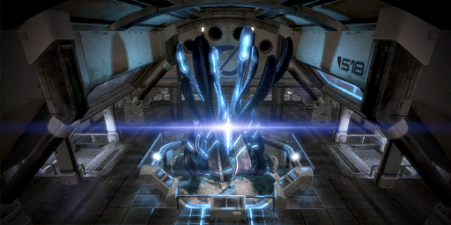
The person being indoctrinated may feel like he or she is being watched, and eventually will begin to believe that the Reapers are sympathetic creatures who deserve all devotion. In extreme cases, the Reapers may “assume direct control” over the body of an indoctrinated individual, making it an undeniable agent of the Reapers.
Still with me? Let’s start testing this process against some game events.
Exposure to Artifacts and Dreams
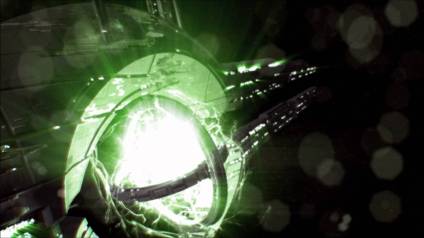
Shepard has been exposed to Reapers quite a bit throughout the series. She not ony interacts with Sovereign in the first game and Harbinger in the second, but also spends some time within a Reaper corpse. If that isn’t enough, she is also exposed to Object Rho pictured above) in close proximity for three to five minutes (approximately) during the events of the Arrival DLC. This is a canon event, as well, as the events of Arrival occur whether or not a player experiences the DLC or not, as it’s referenced in Mass Effect 3 and her actions during the DLC are the reason she is in custody.
Rewind to speaking with the rachni queen in the original Mass Effect. She speaks of a different sort of song that her people heard, an “oily” song with “silver screams” and whispers. Fast forward to Mass Effect 3, and we have a chance to see Shepard’s nightmare, consisting of hazy dreams with dark, shadowy figures and whispering, which become more emotionally trying as the game progresses.
Speaking of which, another detail often pointed out is that in Shepard’s nightmares, Shepard can only move in slow motion. Likewise, when she is walking to the beam during the final battle, all of her movements are slowed, just like in her dream. Some believers in the IT see this as a purposeful parallel between the dreams (happening in her head) and the experience of slow indoctrination (happening in her head). Let’s take a look.
Notice the oily shadows? And the persistent whispering? And the voices of the people taunting her… Kelly Chambers (who, in this playthrough, died when Cerberus attacked the Citadel), Thane, Legion, and Kaiden. All friends that Shepard couldn’t save.
Oh, and the voice of the Illusive Man. Another poor indoctrinated fellow.
This Shepard’s On Fire
Additionally, these nightmares occur after every set-back in the game, or when Shepard’s stress level has increased – meaning she is more vulnerable to Reaper suggestion. The final nightmare sequence shows Shepard kneeling next to the boy. When the pair turn to face (the dreaming) Shepard, they immediately catch fire.
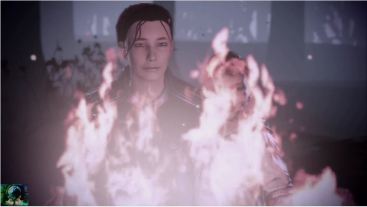
The IT suggests that this is Shepard’s subconscious, symbolically conveying that she, like the little boy back on Earth, is being destroyed by the Reapers. Alternatively, it could be the Reapers trying to drive home the death and destruction that has been haunting Shepard since the beginning of the war.
Boy On Earth and Other Hallucinations
In the beginning sequence of Mass Effect 3, there is a brief clip of a boy running into a building that is destroyed by a Reaper beam immediately afterward. Shepard and Anderson run into that building moments later, and Shepard finds the little boy hiding in a vent. Shepard seems to be the only one who hears the little boy, and when Shepard’s attention is pulled away for a moment, when she turns back to the vent, the boy is gone. More eerily, a Reaper growl is heard in the soundtrack.
This boy returns to the scene later when trasports are readying to take off. The little boy runs to one of the small ships, amidst Alliance officers and other escaping humans. He is completely alone and pulls himself into a shuttle. No one else seems to notice him or try to help this lone child get to safety. The boy makes eye-contact with Shepard before the shuttle departs and is destroyed by a Reaper beam.
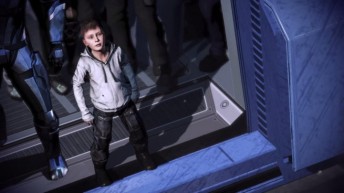
The IT poses that this little boy may have been real when he ran into the destroyed building, but because Shepard seems to be the only one who sees him after that, he turns into a symbol of all the people Shepard couldn’t save (which is what taunts her in her dreams, as well). The Reapers use this imagery to further weaken Shepard’s mental resistance by adding to her emotional stress which, as we’ve discussed, weakens a person’s ability to fight the Reaper influence.
It’s All About Harbinger
Throughout Mass Effect 2, there are moments when the screen becomes rimmed with what looks like blood splatters, forming a circle through which the viewer can watch the action. The angle of the camera implies that the team is being “watched” by someone other than the player. The assumption is that this “watcher” is actually Harbinger, a Reaper with a bit of an obsession with Commander Shepard.
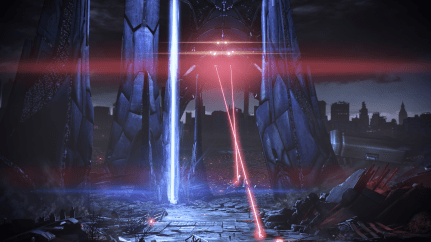
In Mass Effect 3 we see this bloodied-circle effect again, most notably when Shepard opens her eyes and makes the final, painful push toward the beam to be led up to the Crucible. This entire sequence is not only shown through Harbinger’s eye (the red circle), but Shepard also moves in slow motion, like her nightmares, linking the Reaper’s “watchful” eye to the implementation of Shepard’s dreams.
While we’re on the topic of Harbinger, in the Extended Cut Edition, two words of dialogue were added as Harbinger shoots his beam at Shepard. As the beam tears through the ground toward Shepard, stopping before it actually reaches her, Harbinger’s voice growls, “Join us.”
Inconsistencies in the Gameplay
During the final push to the beam, and after Shepard reaches it, a few strange and inconsistent things happen. First of all, after Shepard is knocked away by Harbinger’s beam, when she wakes up we see grass and trees where there were none before. In fact, these are the same kinds of grass and trees in the dream sequences.
Additionally, Anderson reports that he follows you to the beam, but yet he is somehow far ahead of you in the Citadel. “Coming out in a different place” doesn’t make sense, either, as there is only one path to the control panel.

And finally, when the Catalyst introduces Shepard to the choices, the person in the “control” scene looks like a man in a suit (who looks a lot like the Illusive Man), and the person in the “destroy” sequence looks like an Alliance military man with a brimmed cap (who looks a lot like Anderson). Why doesn’t the Catalyst show Shepard completing these actions? Perhaps because, in Shepard’s mind, control is what the indoctrinated Illusive Man wanted, and destroy is what the Alliance part of her wants.
There are a few more interesting details, like Shepard’s injuries, but we’ll look at this a little more in the video below.
Color Reversal
Throughout the entire series, “red” dialogue options have been renegade ones and “blue” options have been paragon ones. Most of the time, people take the word “renegade” and equate it with “bad” (for good reason: BioWare had some real jerk dialogue that Shepard could whip out!), but what the renegade option is, at its core, is the option that gets the job done, no matter what. Paragon is the “play nice and try to convince others of your way of thinking” option.
Standing in front of the Catalyst, we have:
- The red option: destroy
(“We destroy them before they destroy us.” -Anderson) - The blue option: control
(“Control is the means to survival.” – Illusive Man) - The green option: synthesize
(“Is submission not preferable to extinction?” – Saren)
Red and Blue Reversal
Most arguments against the “destroy” option say that the developers are clearly marking it as the “bad” option, since red has stood for renegade during the past three games. But all those people are wrong.

It’s really just a slight misunderstanding. Renegade does not mean “bad.” Renegade means getting the job done no matter the cost. This leads me to two conclusions:
- This is, in fact, the renegade option, because it gets the job done no matter the cost. Shepard has wanted to destroy the Reapers for three games. This does it. Period. Job? Done. Day? Saved.
- Knowing that the players associated “renegade” with “bad,” the developers left the red color in, since this is what the Catalyst shows you. The Catalyst doesn’t like this option. It’s the bad option, according to the Catalyst. So the Catalyst offers this option using the “bad renegade” color to
indoctrinate youget inside your head and manipulate your actions.

The blue option, control, is colored as a paragon choice. Paragon options are usually considered “good,” although in practice they are usually a mediating one, meant to bring another person to see the “reason” of another person’s way of thinking. For instance, during the paragon option to brings peace between the geth and quarians, but Shepard uses her paragon talents to convince the quarians to see things her/the geth’s way. Unlike the renegade option (during which Shepard yells out a reprimand at the quarian fleet), the paragon option convinces the quarians not to do something differently, but to see things differently.
The Green Option
The Indoctrination Theory (from what I’ve seen) tends to dismiss this as “well, this is what Saren did, and it’s therefore bad.” Unfortunately this falls apart against arguments that question why synthesis only becomes available when Shepard attains the highest military readiness score. Following the logic of Shepard being indoctrinated, this option is truly the hardest to attain, after all, destroying and controlling things are easy, but merging two disparate creatures into one takes a lot of skill and more than a little finesse. So it follows that the most difficult option to succeed at would require the most amount of preparation.
But that doesn’t change the fact that Saren, who was indoctrinated, supported this option as the “final solution” to the Reaper threat.
And it’s green… well I don’t have a reason for that, other than it was another “safe” looking color for the Catalyst to use to confuse Shepard/you into believe it’s a good option.
A Few Counterarguments
There are a couple big questions that the IT left in its wake, including:
- Why would the Reapers design a “destroy” option in the Crucible in the first place?
- How does Shepard know the “results” of her decision (e.g., Normandy flying away, etc.)?
- Why do people still believe in the IT after the extended cut explained everything?
I’m so glad you asked!
My Original Thoughts
Prior to reading about the Indoctrination Theory online, my interpretation entailed a hybrid of the Indoctrination Theory points, but also dealt with a few of the lingering questions it left. This is explained a little more in the video I made below, but for starters:
In the game, Harbinger shoots his beam, Shepard goes flying, and we hear comm chatter that no one made it to the beam. Then, once Shepard opens her eyes, we see Harbinger leave. He doesn’t think Shepard is a threat anymore, although he’s still watching her. Everything leading up to Shepard going up into the beam is happening in reality, although Shepard’s perception is altered by Harbinger’s “eye” – his indoctrination attempts. She loses consciousness before actually making it to the beam. The person who actually makes it to the beam is Anderson.
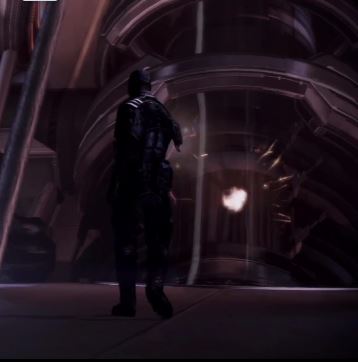
Once inside, Anderson finds and fires the Crucible, as Shepard lies unconscious on the ground, battling for her mind.
But why would the Reapers have a “destroy” option?
They don’t. The Crucible was designed by organics, so it was made to only destroy the Reapers, or perhaps to destroy or control. But the real choice was in Shepard’s mind. I think that by “adding Shepard’s power” (i.e., indoctrinating her), the Catalyst is able to alter how the Crucible fires. This is possible… well this might seem like a terrible reason, but Mass Effect is more science-fantasy than true science-fiction.

Science-fiction tries to explain the science behind the fantastical technologies within in (like Star Trek), and science fantasy just expects you to believe certain things without question (like Star Wars – You’re just expected to believe lightsabers will work because that’s how things are in that universe).With things like Element Zero and biotic powers, VIs becoming AIs, bringing people back from the dead, and being able to mind control people by sticking them in the room with a piece of a robot for a long enough time (all without any real attempts scientific explanation), Mass Effect squarely falls into science-fantasy.
So, following that logic, technically the game doesn’t need to explain how Shepard succumbing to the Reapers could change what the Crucible does. After all, Shepard’s war-readiness is what opens up the synthesis option. Maybe Shepard’s character and strength of will give the Catalyst whatever it needs to be able to fire the Crucible in a way that won’t destroy the Reapers.

How does Shepard know the “results” of her actions? (Normandy flying away, etc.)?
She doesn’t. These scenes are either a hallucination or dream, or – more likely – the game switches between Shepard’s head and actual events, in order to show the player what’s happening. Not everything that happens needs to be from Shepard’s perspective.
But… the extended edition explains everything!
Hackett’s comment that “She did it!” but then says that “someone” made it to the Citadel. Perhaps what “she” did is unite the galaxy and lead a campaign that would beat the Reapers. That doesn’t mean she made it to the Citadel. Considering the man shooting the canister for “destroy” looks like Anderson, an the man holding onto the “control” beams looks like he’s wearing a suit (cough like the Illusive Man), it’s possible that Hackett is right: “someone” made it, but that doesn’t mean Shepard made it.
Shepard wakes up only after the destroy ending.
She only wakes up after the destroy ending because she hasn’t been assimilated into the Reaper consciousness. She has maintained control of her mind. Her fight has been on Earth, and that’s why she wakes up surrounded by concrete rubble, instead of the futuristic material of the Citadel. It also explains why she didn’t burn up on re-entry.
Dear BioWare,
Yes, I am looking for a job and would love to write for you.
Love, Athena
I admit that I have days when I like the Indoctrination Theory (both mine and others’), and days when I think it’s complete nonsense (because who doesn’t sit around and think about the Mass Effect 3 endings every day?). But what really matters is…
What do you think? Does the Indoctrination Theory hold up? Or is it just an attempt by fans to explain inconsistencies using the lore and the Power of Overthinking? Do you subscribe to the Indoctrination Theory? Let me know in the comments!
Thanks for stopping by, and I’ll see you soon!
~Athena
PS Whew! We made it! A whole month of Mass Effect-themed feature posts! With Andromeda here, we might be taking a look forward with the themes that the new installment covers, but I hope you’ve enjoyed looking back at this fantastic trilogy as much as I have!
What’s next? You can like, subscribe, and support if you like what you’ve seen!
– Support us on Patreon, become a revered Aegis of AmbiGaming, and access extra content!
– Say hello on Facebook, Twitter, and even Google+!
– Check out our Let’s Plays if you’re really adventurous!



 Ambigamingcorner
Leave a reply to Reckless Reporter Cancel reply