


We are in the midst of the most important and influential movement in video games in a decade, if not ever – movement that is vital to the ongoing cultural relevancy and maturation of our medium – and almost everyone involved in the conversation is, intentionally or otherwise, looking for ways to ignore everyone else. We can do better than this, and we have to, in order to make progress. – Adam Saltsman, “We Have an Empathy Problem”
A little over two months ago, we talked about identification and representation in games. If you haven’t done so, check it out (and the comments!) because we’ll be referencing things from that article this week.
In that article, we talked a bit about identifying “as” and and identifying “with” a character. Both have their places, because identifying “with” a character means identification with internal characteristics (hobbies, personality, backstory, etc.), and identifying “as” refers to more visible traits (hair color, gender, skin color, etc.). Humans naturally find people that fit into one or both of these categories, although many (including the folks in the comments section of Part I) talked about the importance of identifying “with” a game character over identifying “as” a particular group the character belongs to.

I ended the last article with a question: does all this really matter? If it doesn’t matter your spouse, your best friend’s daughter, me, or you, does it really matter?
Yes.
A Story
My friend The Well-Red Mage and I had a wonderful conversation a while ago about sexism, racism, and the media (because this is what people talk about on Twitter), both defending our own opinions, and both technically falling under “minority” status. He commented that he did not need to feel validated by the media. I disagreed, in relation to myself. But then something happened and I realized that we were using the same words to argue two different points.
About a month ago, The Well-Red Mage wrote a very touching article about fatherhood, playing video games, and selflessness. In addition to his thoughtful comments on fatherhood and an absolutely adorable picture of the littlest Mage to join his family, The Well-Red Mage commented on how fathers are portrayed in the media. He does a superb job outlining how incorrect the depictions of bumbling, foolish dads are, and so I highly encourage you to read his article.

Although he seemed unconcerned for himself and his children (and rightfully so, as I’m sure he’s a great dad), this was a topic that bothered him enough to write about. And so I sat down and wondered why, especially after our conversation.
And then I realized the dichotomy of this issue. There is a societal side, and an individual side.
Idea Exchange
I’ll be honest, I never really thought about fathers in media. I’m not a dad, I’ll never be a dad, and I had a really fantastic dad, so any stupid ideas about fatherhood thrown at me by the media were immediately squashed by my real-life experiences.
But here is a father, confident in his own abilities, commenting on the poor representation of fathers in the media. And he’s right to do so. At a societal level, it matters what media says about our “group.” On some level, it bothers us when our “group” is misrepresented because that’s not what I’m about, gosh darn it!

And it’s so easy to forget that importance when it’s not your group being misrepresented, just like I did until I read the Mage’s article. That’s why it’s important to keep talking about the representation of minorities (and others) in video games. It’s important to go to those uncomfortable places and get to the heart of the issue so we can fight the problems together.
The Sticking Point
As with most hot-button social issues, conflicting research exists on this topic. On the one hand, Bandura’s social learning theory suggests that seeing people similar to us (in real life and in media) is important for learning behaviors, as we imitate others and often imitate people we see as similar to us. This presence can therefore influence a person’s beliefs and behaviors surrounding themselves or a particular “group” of people.
However, other research shows that minorities are better able to relate to majority populations than the reverse of this. So, a person of color will more readily identify with a caucasion person than vice versa. Likewise, women find it easier to relate to men than men can relate to women. But this research also subtly hints that perhaps this discrepancy is due to minorities not being exposed to “themselves,” and so have been forced to adapt and make connections to people not like them, unlike people who fall into the “majority.”
This begins to illustrate one of the most important points of this article: the discrepancy between the importance of representation to an individual and the importance of representation to society.
However, whether you consider yourself part of a majority or part of a minority, or both, depending on your situation, we can all agree that randomly sticking a minority into a story, whether a movie, game, or book, is never the right answer. Making an ethnic “skin” available for a character, or plopping a woman into a story so you can say the cast is “diverse” is not going to win the hearts and minds of the minority you are appealing to, and can actually be more problematic (which is outside the scope of this article).
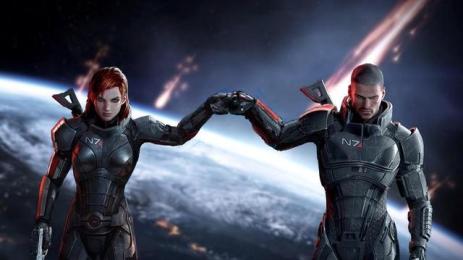
But here’s the thing: most gamers don’t particularly care about what their avatar looks like. Sales for Horizon: Zero Dawn didn’t suffer because Aloy is a woman, Samus Aran is still an incredibly popular character, and Lara Croft is still selling games after all these years. So it seems like representation is a non-issue… Except the way representation in games is treated suggests otherwise. But let’s take a step back for a moment.
Video Game Drama
If you’ve been following AmbiGaming for a while, you’ve read a few articles about how games allow us to explore things that we might not otherwise experience in our lives, and let us do so in a safe, non-threatening space. Yet (until very, very recently) it seemed like video games would shy away from involving themselves in more “difficult” social issues like race, gender, sexuality, and the realities of things like war and poverty. But video games have a unique opportunity: their inherent playfulness enables them to address these issues in a way that doesn’t sound like a lecture, yet still send important messages in understandable and palatable ways.
These proposed changes are not a ploy for greater profits, and changing will not affect sales, as we’ve seen with recent releases. If video games are to be taken seriously like other media (e.g., books, movies, art), they cannot forever avoid reflecting, in some way, the society in which it exists.
Putting the Pieces Together
There are two sides to this issue: the personal and the social-political. On a personal level, representation isn’t needed for personal validation, as we saw with my friend The Well-Red Mage. He will be a good father regardless of what media portrays. But the fact remains that, on a societal level, we are being bombarded by depictions of horrible dads, and that’s troubling because, as we saw, media influences our view of ourselves and how others view our “group.”
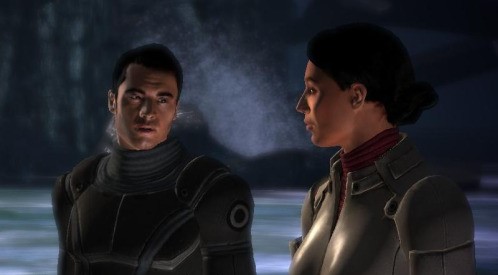
Many minorities will say they don’t “need” media to validate them on a personal level. And perhaps this is true. But these same minorities have also never been represented in media, and so no longer expect it, either. It is apathy has been bred by resignation. I don’t need to play as a homosexual woman in a game to enjoy it, and I have long stopped looking for “myself” in a video game, but it was so nice to see Samantha Traynor – a gay woman who isn’t a stereotype – in a AAA game. That meant that, finally, society saw someone “like me.” For a moment, I wasn’t invisible on a societal level. After all, I exist in the world. Why shouldn’t I be reflected in the media?

So we’ve returned to the idea of media not being needed to validate other people, thus making representation seem like a non-issue. But if so many people think that representation in video games is a non-issue, why aren’t minorities better represented?
This continued lack of representation seems to suggest that representing minorities still is an issue, as alluded to by this article talking about Sony’s fear of supporting minorities as protagonists and this article suggesting that the industry will assign someone to animate a horse defecating before it includes realistic minority representation in games.
So I ask again: if representation is a non-issue, why not include more minorities? It shouldn’t matter, after all.

Some may argue that people who support representation in games (like me) should just not play the games without representation. This is like saying to someone that they simply should not watch any of the horror movies that victimize women if that is not what they’d like to see.
This is true, but to a point. I can avoid a movie or two, or not pick up a game I don’t think I’ll like. But it is not the responsibility of each individual to avoid all potentially “offensive” content – it is up to the society to notice who is always being marginalized or excluded, and then take steps to mediate that problem.
Media representation reflects who people are, and also shows them who they might become. It shows what is, and also what is possible. Video games are in a unique position. They give us opportunities to explore and experience worlds and events that we would not be able to otherwise. They can challenge us in a fun way, and that challenge can certainly be in the form of gameplay mechanics, but they can also challenge our morality and face us with difficult social issues. And they can do it in a way that doesn’t reduce gaming’s natural playfulness.
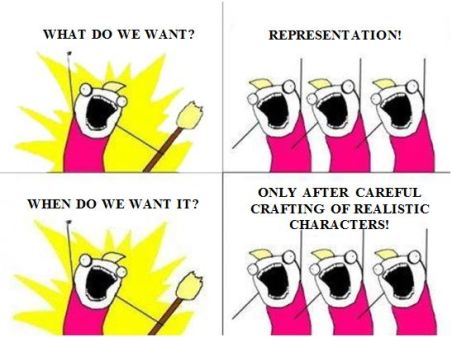
We’ve come a long way, and conversations around games are definitely changing. But it’s only through continuing to talk about these issues that we can begin to imagine a much more inclusive future. And wouldn’t it be nice to see video games leading the charge to true equality?
What do you think? Is minority representation in the media important for a society? Why or why not? Let me know in the comments!
Thanks for stopping by, and I’ll see you soon!
~ Athena
**This article has some extra content available over at Patreon, if you are so inclined!**
What’s next? You can like and subscribe if you like what you’ve seen!
You can also:
– Support us on Patreon, become a revered Aegis of AmbiGaming, and access extra content!
– Say hello on Facebook, Twitter, and even Google+!
– Check out our Let’s Plays if you’re really adventurous!


 Ambigamingcorner
Leave a reply to the Well-Red Mage Cancel reply