


Happy N7 Day!
You may have noticed all of the Mass Effect posts flying around here, particularly in celebration of this month marking the 10th anniversary of Mass Effect’s release. So, to keep the celebration going this N7 day, the fantastic Shelby from Falcon Game Reviews and I put our heads together for a massive collaborative project discussing the latest addition to the Mass Effect family: Mass Effect: Andromeda.
What follows is part one in this miniseries, brought to you in the discussion format in which this project took place. We hope you enjoy the discussion, and look forward to continuing the conversation in the comments! Take it away, Shelby!
Shelby: Anyone that has been caught up on gaming news this past year has definitely heard about the big stink surrounding Electronic Arts and Bioware’s Mass Effect: Andromeda (ME:A). Whether it was the questionably implemented animations, stilted script, or dangling plot hooks, there has been great scrutiny of the franchise’s newest entry.
With the latest revelation that the fate of the Quarian Ark, the Keelah Si’yah, would be relegated to being divulged in a book format, Athena and I spiraled into a discussion about the topic of what happened to ME:A.
So are you ready? Because we’re about to dive down this rabbit hole.
Discuss!
Athena: One of the foundations of “what happened” is a bit of what they tried to do versus what they did. The original intent of the game was to allow the player the level of exploration that Mass Effect was supposed to deliver but couldn’t, to the point where Mass Effect: Andromeda’s original state looked a lot like No Man’s Sky, insofar as it would be procedurally generated. Someone (luckily) realized that that would be disastrous for an RPG, but the desired size of the game still remained.

From a story standpoint, ME:A was supposed to reset the series and, as I played through a second time just playing main story missions, it seemed like they took a lot of elements from the original trilogy. While Ryder wasn’t a war hero like Shepard, Ryder was on a peaceful-mission-gone-wrong, just like in Mass Effect, had a set of complicated crew who all had complex and interesting side-quests like in Mass Effect 2, and had a clear and present danger that was bent on destroying the galaxy right now like in Mass Effect 3. They even had a Harbinger-like character in the Archon, who took a strange, personal interest in Ryder the same way Harbinger did in Shepard.
For all intents and purposes, it took what people loved about the original trilogy and tried to put it into a game. Other games (like RiME) have payed homage to the things that came before, and while they might be dismissed as being not creative (which I personally don’t agree with but which is also a discussion for another time), that doesn’t make a game bad. So I guess the lingering question for me has been – and still is, a bit – how does a studio take all the best parts of three games, and create a game that so many people hate?
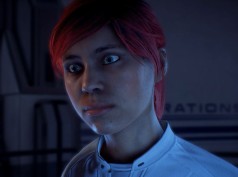
Was it really all the facial animations and an internet-wide tantrum? Was it RPG bloat? Or was there something really missing from the experience?
Shelby: It was definitely a combination of factors.
I know we both found that Kotaku article covering the development of ME:A, and the progress that was made. I don’t think that the development process was nearly as short as many made it out to be (certainly not the alleged “18 months”), but I know that’s what folks tend to point to when talking about the game. Looking back though, I think Bioware turned to making ME:A a bloatbox as a way to pad the runtime. Not because that’s what they wanted for the game, but just as a way to try to fulfill the original vision with less resources.
Interestingly, that original vision seemed to be more along the lines of No Man’s Sky than Dragon Age: Inquisition in space. They apparently wanted to pair the Mass Effect universe with procedural generation with the aim of giving players hundreds of worlds to explore, not just five.
If anything, I think that Bioware’s ambitions got the better of them, and EA’s hamstringing of the development studio didn’t help.
I feel like I’m missing something…
Why do you think ME:A garnered so much negative attention? I can’t seriously believe that it was just the game. There was just too much passion surrounding the criticism.
Athena: I wonder sometimes if BioWare, in a way, suffers from being too clever for its own good. I’m reminded of Dragon Age II, and my own negative reaction to it because I just wanted more Dragon Age: Origins. I latched onto the copy/pasted environments because I didn’t consciously realize I wanted more DAO. Dragon Age II is, likewise, a solid game with an intriguing story. It’s not perfect and some story elements could have been expanded on, sure, but it’s not the horrific mess it’s made out to be.
I think fans tend to like what’s familiar. They wanted more Shepard (and some have said as much, even if they didn’t realize how important that statement is when trying to figure out the game’s supposed “failures”). Shepard was a war hero-turned-demigod, and Ryder had to follow that up. So Ryder’s character was pulled back, like DAII pulled back from DAO, in order to prevent a sort of “power creep” in the games. And the fans hated it. Hate might be a strong word, but definitely had a strong reaction to it, at least.

I have this theory that, to a certain extent, gamers don’t really know what they want until they have it handed to them. But, when making a “big change” to what might be expected, all of the pieces need to fit together well, and I think that’s the part that MEA had issues with. Some of the parts just didn’t fit (or were too big to be able to capture the details that would have made the game special). I’m not sure though. Is misplaced passion enough to blind people to an otherwise good experience?
Shelby: I feel like you hit the nail on the head with the comparison to DAII. Both ME:A and (allegedly) DAII spent significantly less time in development than their predecessors, which served as a catalyst for criticism (in part at least).
Obviously the circumstances were different, but the result was fairly similar.
And boy, there were some big shifts made to the type of protagonist. Ryder and Shepard fit a similar role, but you’re right that there’s a big difference between Shepard’s god-like status, compared to Ryder being more of an average nobody.

Athena: I actually liked that arc with Ryder. For me, it was sort of refreshing to watch an average nobody try to rise to the occasion. It made the bond with the crew more realistic because they might be the only ones who still see Ryder as an actual person, not a symbol (either of the Initiative or of humanity or of the Milky Way). I think that’s significant. Should we talk about what the game did right before we try to figure out what went wrong?
Shelby: I’d say that’s fair.
I do agree that Ryder’s rise to the occasion isn’t a bad approach; it’s the same approach that was taken with Shepard originally, after all. If you recall, Shepard’s fame/infamy only took hold after the events of the first game. Before ME2, Shepard was really only well known within the Systems Alliance military.
That would explain why Ryder’s crew members had a such a strong relationship with the player character. The character growth of both Ryder and Shepard mirrored each other rather well.
Of course, I couldn’t mention the good about ME:A without mentioning that they Nomad is vastly superior to the Mako.
Athena: Nooo! I love the Mako! You’re right, though. Objectively the Nomad has fantastic controls and handles in what I imagine is more of a lifelike fashion. Although I loved being able to drive up 90 degree walls because “screw you I’m the Mako.”
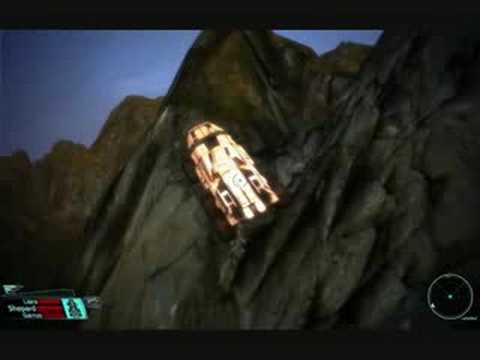
Shelby: I will admit, the Nomad annoyed me with its inability to handle a 30 degree slope. 6-wheel drive, and it can’t climb a hill that a Prius could? I’m calling BS.
I’d be remiss if I didn’t mention that the controls in general were pretty fantastic. I always felt like they did a wonderful job translating the strengths of ME3 to the Frostbite engine. That, and players are afforded a character development approach more similar to games like Skyrim or Fallout. The only limitations placed on the player being where he or she wants to specialize.
It also looks pretty damn fantastic most of the time…
Athena: That’s what the “special gear” was for, wasn’t it? No, that sort of bothered me, too. But it definitely got the crew in and out of tough situations and could really take a beating. I remember it was on fire for a few miles before I finally got to a safe area, so I can’t hate it too much…
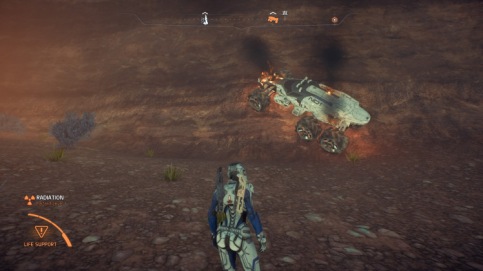
The controls were great. They felt a little more like those of a shooter – definitely building on ME3’s foundation – but everything was smooth, and I really loved that there was so much flexibility in how the character could be build. I’m going back to Dragon Age again, but one of my favorite things about that series was the flexibility in Dragon Age: Origins. So what if I want to be an infiltrator who can shoot fireballs out of my hands and also drill an enemy between the eyes from 100 yards away? I’m always a fan when the limit on character builds is only the player’s imagination. The ability to switch classes was neat, as well, even though it wasn’t something I personally used.
Well, Frostbite does environments well. I don’t think anyone can argue that the planets and scenery were gorgeous.
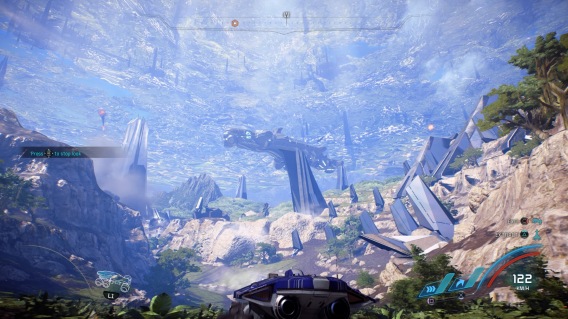
Overall, I thought the game was mechanically well done. The map wasn’t confusing, we could skip some of the traveling cutscenes, transitions between areas were smooth. Inventory was easy to manage (as well as you can manage inventory in an RPG), and I loved that you could turn off the “intonation” cues on the dialogue wheel. I did that right at the beginning of the game, and had a great time picking dialogue after that. Especially if you weren’t sure if a new option was a “flirt” option or a “new conversation path” option…
Shelby: I definitely agree about the dialogue trees, but I can’t get past some of the dialogue itself. It felt forced at times. Like the conversation itself was a means to an end; that it served little purpose other than to deliver the player to a reward or checkbox.
I mean, I do understand that conversations in video games are that way because they are a means to an end, but I’d prefer that dialogue sound natural.
If freedom was something that Bioware wanted players of ME:A to feel, then I feel like they did a good job. They gave players plenty of stuff to do, but I kept getting the notion that Bioware was spitballing ideas.

For instance, the situation on Elaaden, when you first set up an outpost. You get the option of setting up a scientific or military outpost; the implications of which seemed to be how defensible the Andromeda Initiative is, and how they’re viewed by the inhabitants of the Heleus Cluster. Perhaps I shouldn’t have assumed one way or another, but I got the impression that it would be a recurring theme. Instead, Elaaden was the first and last time you make a choice like that.
It was pretty disappointing to say the least.
Maybe it’s just me, but it seems like ME:A is full of half-measures and abandoned threads…
Athena: I can see what you mean about the dialogue. The main story quests seemed to be better orchestrated overall, compared to the sidequests, but for me it seemed like the emphasis on the “main side quests” was the same as the “side side quests.” Like, I would have preferred more decisions like the one you mentioned on Elaaden, at the cost of having fewer “bloaty” missions. I think the only time that choice came up was in Liam’s quest, because they show up and (because I set up a scientific outpost) they hacked into the enemy’s systems. I assume if they were military they would have stormed the gate (especially since the mayor comments on them being scientists and not being able to do that).
You’re on to something with ME:A being full of really great ideas that just weren’t followed through on. I wondered if they left threads out because they wanted to incorporate DLC (a la From Ashes), but I don’t think so. I think some of the details of the game just hadn’t been worked out.
Which brings us to the question, what went wrong?
Whew! There’s obviously a lot more to this conversation, and next time we’ll be delving into what might have happened to make a game that has some very obvious merits garner such harsh criticism. Join us next time as we talk about the game’s launch, and what may have happened behind the scenes to cause some of the long-lasting problems with the game/the game’s reception.
What are your thoughts? What were your favorite parts of Mass Effect: Andromeda? Do you hope to see the series continue? Let us know in the comments!
Thanks for stopping by, and I’ll see you soon!
~ Athena (and Shelby)
What’s next? You can like, subscribe, and support if you like what you’ve seen!
– Support us on Patreon, become a revered Aegis of AmbiGaming, and access extra content!
– Say hello on Facebook, Twitter, and even Google+!
– Check out our Let’s Plays if you’re really adventurous!



 Ambigamingcorner
Leave a reply to Mass Effect Month: Day 29 – To Boldly Go – AmbiGaming Cancel reply