


A long, long time ago, on a blog page far, far away, I shared some thoughts about Dragon Age II. I gave some background on the game, and talked a bit about some of my frustrations with it, but eventually meandered around to thinking that the game overall did what the second game of a trilogy should do, and that its positives were grossly overshadowed by the copy/paste environments, and also my own desire for Dragon Age II to simply be more Dragon Age: Origins, in the same way I was overly hard on The Legend of Zelda: Skyward Sword because I wanted it to be more The Legend of Zelda: Twilight Princess.
Perhaps last year, I decided to play through Dragon Age II again, hoping that playing the game again after some time would yield different feelings toward it. And I’ll be a Dalish’s uncle if that’s not what happened.
Time of Your Life
This wouldn’t be the first time that the timing of playing a game has affecting my feelings on it. Knowing from the start that Dragon Age II is its own game, and not a direct following of Dragon Age: Origins was Dragon Age: Origins – Awakenings DLC, I went in ready to just accept the game for what it was – whatever it was – and glean from it what I could, just like I would for any new gaming experience.
Two points immediately stuck out to me: one was my interactions with the characters, and how they changed from last time, and the other was the themes that I focused on.
Personal Feelings
I always appreciated this meme:

Often, this is how I wind up playing games, first because I don’t generally like antagonizing people without good cause, and secondly because I know that being friends with NPCs also tends to unlock different content. And so, I dutifully sank hours into my first playthrough, trying to balance which companions I took on which quests, because I wanted to get everyone to the max “friend” rating of approval. This playthrough, I had my favorites, and my Hawke traveled with them and only them (with few exceptions) so while I was getting close to Isabela and Merrill and Aveline, poor Fenris and Anders and Varric were mostly being neglected.
While usually this would bother me, I wasn’t particularly upset this go around. It was strange to get to the end of the game and realize I hadn’t done a few personal missions, and even stranger when I realized the reason why, but overall I was pretty pleased with the game and the characters I neglected were the characters I hadn’t particularly cared for the first time around. It was somewhat freeing to not have to run around with characters I didn’t like, just for the sake of a trophy.
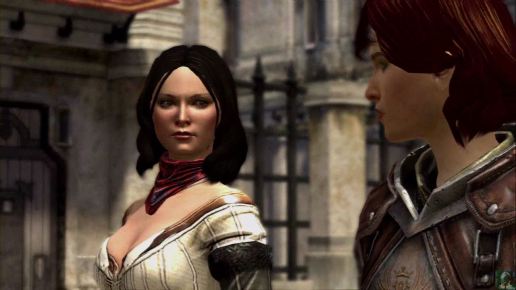
Another change was my taste in romances. During my first playthrough, I was very much pursuing Merrill. This go around, I was attempting to complete something called a “rivalmance,” in which the companion character is at a 100% rivalry rating with Hawke, but still in a romance with her (using female pronouns as my Hawke was female). I chose this because I am rather fond of the character arc she goes through, having seen it in a playthrough.

But around halfway through my Hawke decided she was going to pursue Isabela, and that turned into a much more satisfying relationship than the rivalmance that I wound up messing up anyway.

All this to say, playing Dragon Age II this time around, with a focus of just goofing around and trying out different things, was a much more satisfying game experience than playing it with the same fervor with which I play(ed) Dragon Age: Origins.
However, it wasn’t just a change in personal relationships that I noticed. The way I engaged with the main conflict had also changed, again, I believe, influenced by when I played the game this time.
Impossible Choices
There are a number of plot points that Dragon Age II weaves into itself, from introducing red lyrium, to hinting at an impending qunari invasion, to the main conflict between the mages and templars, which I’ve talked more about here. Ironically, the linked post is from early 2017, during which I was making a comment about then-current events. And here I am again, using the same conflict to talk about current events. I’d give it a quick read if you’re able, because I might reference some points here that are addressed in more detail there.
The mages and the templar have quietly been at odds for some time, and when I first played Dragon Age II, while I sympathized with the mages, I would up siding with the templars during the endgame because of how I was role-playing that Hawke. It seemed reasonable that Hawke side with the templars, after almost every mage not under templar control was a murderer, and after the high enchanter was involved in a situation that led to a mage killing Hawke’s mother. Of course the mages needed to be kept in line: look how they behaved otherwise.

On another pass, I sided with the mages, somewhat disgusted that I had sided with the templars previously, because the answer to rebellion against oppression shouldn’t be more oppression. During this playthrough, I found myself just as angry at Anders for his antics as I had been in the past playthrough. Oppression is bad, but terrorism is never called for, said I, firmly in Camp Moderate Political Viewpoint.
This go around, I found myself disgusted with both sides. On one side were the templars, wanting to maintain the status quo, even at the expense of others, because the status quo had “worked” for so long. On the other side were the mages, oppressed and ignored for so long they resorted to more and more extreme means of demanding change, including murdering innocent people.
On one side were the templars, wanting to protect the people from the rebelling mages, and on the other side were the mages, seeing a better, more inclusive way of running society.
On one side were the templars, refusing to listen to the mages. On the other side were the mages, refusing to listen to the templars.
And little by little, even the templars and mages began to fracture within their own groups, distancing themselves from other factions that seemed so different in practice and in words, although were the same in ultimate goal. But there was too much hurt on both sides for any to see this.
Sitting on the sidelines, knowing the story, it was easy for me to look at First Enchanter Orsino, and the templar Knight Captain Meredith, and dislike both of them. Orsino was not the best representative of what mages could be, and Meredith was a tyrant who – while one could believe in some of the words she said – acting so abhorrently that it boggled my mind how her templars could follow and defend her.
This playthrough, it felt like neither choice was ideal, and all I could do was go with the one I thought would cause the least amount of harm. Survival was necessary now. Idealism could come later.

It’s interesting that when we play games can have such an impact on what we take away from them, no?

Maybe Flemeth is right. But that doesn’t mean we don’t try to fly.
Have you ever played a game for which your opinion changed as time went on? What was it? Did you ever find yourself gleaning different themes and ideas from the same game, based on current events? Did you vote? Let me know in the comments!
Thanks for stopping by, and I’ll see you soon!
~Athena
Do you like what you’ve read? Become a revered Aegis of AmbiGaming and show your support for small creators and for video games as a serious, viable, and relevant medium!




Leave a Reply